
Landscape lighting · Installation
Not more light. Better contrast.
Stone that glows, canopies read as moonlight, a walk that leads instead of dotting. One warm tone across the property, nothing aimed at where you sit. Solid brass at 3000K, designed on your property with the fixtures in hand and aimed on a separate visit once it's in the ground.
What it actually is
A third lit. The rest left alone.
The instinct is to light everything, and the result is a flat, evenly bright yard where nothing stands out because everything competes. Good landscape lighting works the other way around.
We light roughly a third of what's out there and let the rest fall into darkness. What you leave unlit is as much of a design decision as what you light — the dark between two lit trees is what makes either of them read.
The disciplines within
Six techniques, chosen per element.
Path lighting.
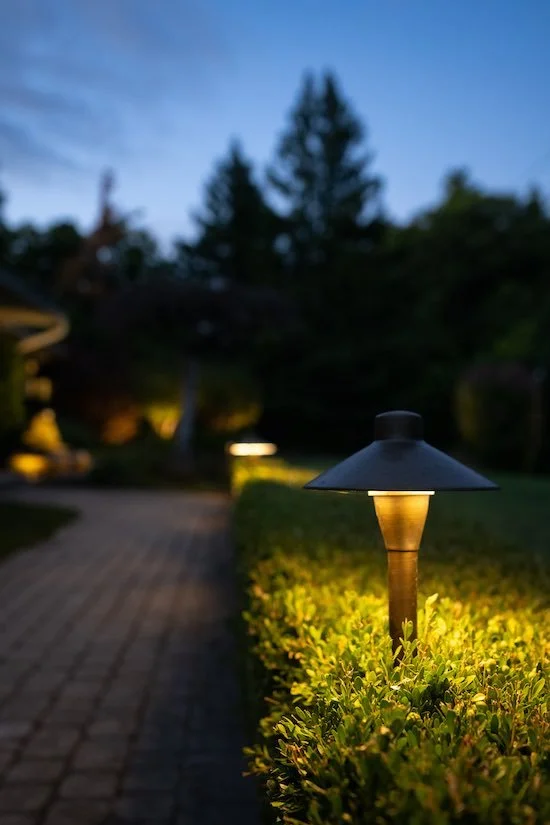
Hat-shade fixtures at knee height, spaced so pools overlap only slightly. Enough to read the edge of the walk, never a runway.
Circulation ii.Uplighting.
Trunk and canopy from below, two sides for depth. Narrow spread on columnar trees, flood on a broad maple.
Specimen trees iii.Downlighting & moonlight.
Fixtures mounted high in the canopy, shielded, throwing dappled light down through branches. The most natural effect available.
Mature canopy iv.Grazing.
Fixture close in, aimed steeply, raking across stone, brick or a clipped hedge so texture becomes the subject.
Texture v.Bed & garden.
Well lights and low bullets inside planting, invisible by day and doing all the work once the system is on. Re-aimed each season as beds fill in.
Planting vi.Hardscape & steps.
Riser and wall lighting for grade changes, integrated into stone rather than stuck onto it. Safety that doesn't announce itself.
Grade & safetyWhy brass
Aluminum is cheaper on day one. Ask about year six.
Aluminum fixtures pit, chalk and start letting water into the housing within about six years — faster near road salt or a pool deck, where the chloride load is highest. Once water is in the housing the failure isn't the fixture, it's the wire.
We specify solid brass and copper on every project, with a lifetime fixture warranty. Brass doesn't corrode; it patinas, going from bright gold to a dark bronze over three or four seasons, and then stops changing. The fixture you buy is the last one that goes in that hole.
The standard
What's fixed, on every project.
-
i.
3000K warm white, universally.
Warm white makes brick, limestone, cedar and foliage read the way they do by firelight. Above 3000K the light turns commercial — 4000K makes green foliage go grey and skin tones go bad. We don't install cool light, even on request, without a written note that we advised against it.
-
ii.
Dark-sky by default.
Shields, glare guards and hex louvres on anything aimed up, and aiming angles that put light on the target instead of into your neighbour's bedroom or the sky. Full-cutoff fixtures wherever a downlight is possible.
-
iii.
Sealed direct-burial connections.
Every joint is a gel-filled, direct-burial connector rated for the application. No twist caps, no electrical tape, no junctions left in a valve box to be found in five years. This is the single most common failure we find in other people's systems.
-
iv.
Transformers sized with headroom.
Loaded to roughly 80% of rating, on multi-tap secondaries so voltage drop at the far end of a long run is corrected at the transformer instead of being lived with. Zoned so scenes are possible without rewiring.
-
v.
Aimed on a separate visit.
Installation and aiming are different jobs. Aiming happens with you present, fixture by fixture — and then again inside 30 days once you've lived with it.
Landscape lighting questions
Answered plainly.
What fixtures do you use, and why brass?
Solid brass and copper, low-voltage, with integrated or replaceable LED lamps at 3000K — the full specification is published. Installed, that runs from $250 per fixture — hardware, wire, trenching, labour and commissioning together — rising to about $400 on estate grounds, where wire and transformers scale faster than fixture count does. A custom finish or optic adds about $150, and the minimum project is $3,000. Brass is specified because it doesn't corrode — it patinas to a dark bronze over three or four seasons and then stays stable for decades. Aluminum, which is what most package systems use, pits and chalks within about six years in Ontario, and faster near road salt or pool decks; once water gets into the housing the wire fails next. Our fixtures carry a lifetime warranty against corrosion and housing failure, which is a claim only brass makes affordable to honour.
Why 3000K, and never cooler?
Because 3000K is warm white — close to the colour of an incandescent lamp — and it's what makes brick, limestone, cedar and foliage look like themselves once they're lit. Go cooler and the property turns commercial: at 4000K green foliage reads grey-blue and stonework looks bleached, which is why a parking lot and a garden should never share a lamp. Warm light also produces less glare at the same perceived brightness, so a 3000K system runs at lower output and still reads clearly. We install 3000K on every project. If a client insists on cooler, we'll do it — with a written note that we advised against it.
What does the lifetime warranty actually cover?
Fixture housings and the sealed connections we install: corrosion, water ingress and mechanical failure of the brass or copper body, for as long as you own the property. LED lamps and drivers carry their manufacturer's warranty, typically five to seven years, and we replace those at cost during a maintenance visit if they fail after that. What isn't covered is physical damage — a fixture run over by a lawnmower, hit by a plow, or dug up by a landscaper. Those get replaced at fixture cost with no labour charge if we're already on site.
Will it work with the system I already have?
Sometimes, and the $195 inspection is how we find out. Good brass fixtures on a properly sized transformer can usually be absorbed into a new design — we re-aim them, replace lamps, and extend zones. Pitted aluminum housings, twist-cap connections in soil, or a transformer already loaded past 90% of rating are all reasons to start over. The inspection documents every fixture, zone and connection in writing and tells you which category you're in. Roughly half of the existing systems we inspect keep at least their transformer and trunk wire.
What does landscape lighting actually do for a property?
Four things, in the order homeowners notice them. It returns the elevation you paid for — a facade, an entry and a specimen tree read from the street again instead of going flat at eight o'clock. It makes grade safe: steps, level changes and the drive-to-walk transition stop being guesswork. It adds hours to a yard you already built, because a lit patio and a lit path back to the house get used in September and October. And an occupied-looking property on a timer deters more than a motion floodlight does, without the glare.
How does an Ontario winter affect a lighting system?
More than anything else on the property. Forty degrees of swing between January and July works at every gasket and connection; frost heave rotates a staked fixture a few degrees over a winter, which is enough to slide a pool of light off a trunk; road salt and pool chloride attack housings; and plows find whatever sits too close to the drive. That is the whole argument for solid brass, gel-filled direct-burial connectors, wire at depth and one re-aiming visit a year. Aluminum systems installed with twist caps are the ones we get called to replace at year six.
How long does a landscape lighting system last?
The brass outlives the mortgage. Realistically: fixtures 25 years and up, LED lamps five to ten years depending on run hours and heat, transformers 10 to 15 years, and wire indefinitely if it was buried at depth with sealed joints. What actually changes is the property — trees grow into the beams, beds fill in and hide fixtures, and grade shifts with frost. That's why maintenance is re-aiming first and repair second. A system that gets walked once a year looks the way it did at commissioning a decade later.
Your property, next
We'll light your actual trees. Then you decide.
We come out after dark and light your actual trees temporarily, so you can stand in it before you commit to anything. Free, 45 minutes, no renders.
Book a consult All services