

Design expertise
Anyone can add light. Design is deciding what stays dark.
How we arrive at a specification: the principle behind every design, the techniques we choose from, and the standards that don't change from one project to the next.
The governing principle
Contrast, not brightness.
The eye reads a scene by comparing light against dark. Flood a property evenly and you take that comparison away: everything is visible and nothing stands out, which is why over-lit yards look flat however bright they are.
We light perhaps a third of what's there and let the rest fall away. The dark between two lit trees is what makes either of them read. It's the hardest thing to believe before you've seen it, which is why we show you on site.
Almost every adjustment on the aiming visit turns output down, not up.
The techniques
Six techniques, chosen element by element.
- i.
Path lighting.
Hat-shade fixtures at knee height, spaced so their pools only just overlap. Enough to read the edge of the walk, never a runway.
- ii.
Uplighting.
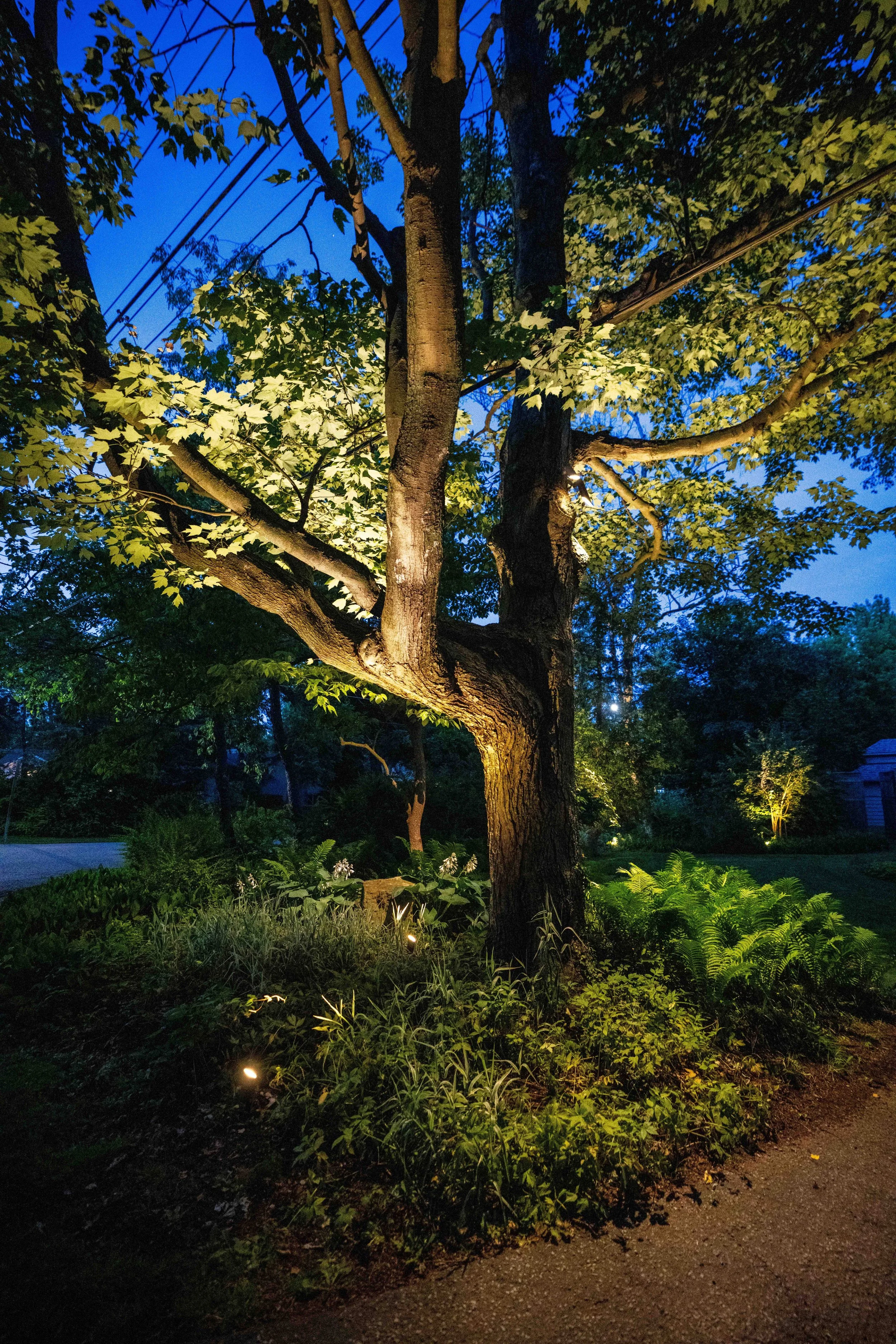
Trunk and canopy lit from below, from two sides for depth. A narrow beam on a columnar tree, a wide one on a broad maple.
- iii.
Downlighting and moonlight.
Fixtures mounted high in the canopy, shielded, throwing dappled light down through the branches. The most natural effect there is.
- iv.
Grazing.
The fixture set close in and aimed steeply, raking across stone, brick or a clipped hedge so the texture becomes the subject.
- v.
Bed and garden.
Well lights and low bullets inside the planting, invisible by day, re-aimed each season as the beds fill in.
- vi.
Hardscape and steps.
Riser and wall lighting for grade changes, built into the stone rather than stuck onto it. Safety that doesn't announce itself.
The standard
What's fixed on every project.
- i.
Solid brass and copper.
Aluminum pits and chalks within about six years in Ontario, faster near road salt or a pool. Brass patinas to a dark bronze over three or four seasons and then stops changing. Lifetime fixture warranty.
- ii.
3000K warm white, universally.
Warm white makes brick, limestone, cedar and foliage read the way they do by firelight. We don't install cool light, even on request, without a written note that we advised against it.
- iii.
Dark-sky by default.
Shields, glare guards and louvres on anything aimed up, full-cutoff fixtures wherever a downlight will do, and output no higher than the effect needs.
- iv.
Sealed connections, headroom in the power.
Gel-filled direct-burial connectors at every joint, never twist caps in soil. Transformers loaded to about 80% of rating, with taps that correct voltage drop at the end of a long run.
Built for this climate
Ontario is hard on buried hardware. That's the whole spec.
Forty degrees of swing between January and July works at every gasket and joint. Road salt and pool chloride attack housings, frost heave turns fixtures over a winter, and a plow finds anything set too close to the drive. The standard above exists for those four reasons, along with one maintenance visit a year to re-aim what the ground moved.
Design questions
Answered plainly.
How much of a property should be lit?
About a third. Light everything and the yard goes flat, because nothing stands out when everything competes. We choose the facade, two or three specimen trees, the entry, a stone feature and the grade changes you walk on, and leave the rest dark on purpose.
Why 3000K and never cooler?
Warm white at 3000K makes brick, limestone, cedar and foliage read the way they do by firelight. Above that the light turns commercial: 4000K makes green foliage look grey. We do not install cool light, even on request, without a written note that we advised against it.
Why design on site instead of from a plan?
Because a drawing cannot show how a property reads at night. Beam spread, mounting height and how a facade answers a grazing angle depend on the actual stone, canopy and sight lines, so we demonstrate with the same brass fixtures we install, on your property, after dark.
Will the lighting bother the neighbours?
Not if it is aimed properly. Shields, glare guards and louvres go on anything aimed up, full-cutoff fixtures are used wherever a downlight will do, and output stays low. Your light belongs on your property, not in a window or the sky.
See it demonstrated
The techniques, on your own property.
We come out after dark and show you each effect on your own trees and stone before anything is specified. Free, 45 minutes, no renders.
Book free evening demo 888-444-1530