

Services · Architectural lighting
Architectural lighting. Light the house, not just the yard around it.
Facade grazing, columns and porticos, soffit downlights, stone and brick texture. The beam angle and mounting distance are set to the material, so the house reads as stone and brick after dark rather than a bright, flat wall.
What it actually is
Reveal the texture. Don't flatten it.
Point a wide floodlight at a stone facade and every joint and chisel mark disappears under light arriving head-on. It's the most common mistake in exterior lighting, and the reason so many lit houses look flat at night.
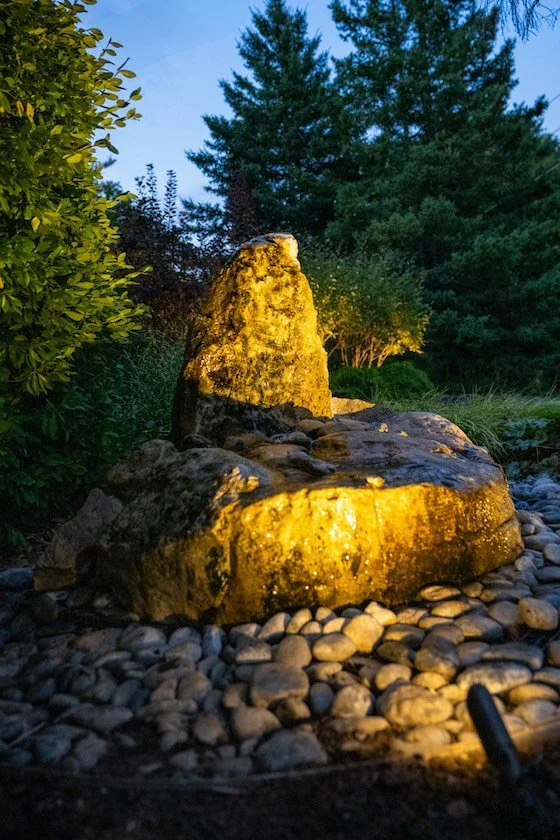
Light that grazes a surface from close in rakes across it and throws a small shadow off every edge. That's what makes stone read as stone and brick as brick. On smooth stucco or panel the opposite is true: the fixture moves back and the light washes evenly, because grazing would show every flaw in the finish.
Which one your house wants is decided on site, after dark, with the fixtures in hand, not from a drawing.
The technique
Four decisions that make or break a facade.
- i.
Distance from the wall.
Tight to the wall grazes the surface and brings out texture; further back washes it evenly and calms it down. Rough stone and board-and-batten want grazing. Smooth stucco and flat panel almost always want washing.
- ii.
Beam spread per feature.
A column takes a narrow beam; a broad gable takes a wide one; a tall chimney usually takes a medium beam from further back. The same fixture repeated across a whole elevation is how hot spots and dark gaps happen.
- iii.
Symmetry, and when to break it.
Formal brick and stone houses want balanced, repeating treatment, where anything lopsided reads as a mistake. Contemporary houses often want the opposite: light one mass, leave the next one dark, and let the shape of the building do the work.
- iv.
Keep it out of the windows.
An uplight in the wrong place throws glare straight into a bedroom. Every fixture is shielded and aimed so the light stays on the wall, and we check from inside the house as well as from the street.
Where it shows
The part of the house everyone sees.
The inside of a house is seen by the people you invite in. A lit facade is seen by everyone who drives past, every evening. It's usually where a project starts, and it pairs with curb appeal lighting on the walk and the frontage.
Architectural lighting questions
Answered plainly.
How much does architectural lighting cost?
A front elevation on its own usually lands in our Economy tier, $3,000 to $5,500 for 10 to 20 fixtures. Combined with landscape lighting across the property, most homes land in Signature, $5,500 to $11,000. Every range includes fixtures, wire, transformers, trenching, commissioning and warranty. See pricing.
Will the fixtures damage my stone or brick?
No. Most fixtures sit in grade or in the planting, not on the building. Where one has to be mounted, on a column or under a soffit, we fix into mortar joints rather than the face of the stone, so it can be removed and patched later.
Can you light a heritage home?
Yes, with restraint. We mount reversibly, keep hardware out of the sidewalk view, and use fewer fixtures on the facade than you might expect.
Will the light shine into our windows?
It should not. Every fixture is shielded and aimed at its target, and we check from inside the house as well as from the street during commissioning. Light belongs on the stone, not in a bedroom.
Goes with
The facade is one layer of the evening.
Most designs pair the facade with landscape lighting in the garden and curb appeal lighting on the approach. We work across Toronto, Oakville, Burlington, Mississauga and Vaughan, and further out.
All servicesYour facade, next
We'll light it on the spot, after dark.
We bring the same brass fixtures we install and light your actual facade temporarily, so you see the effect before anything is specified. Free, 45 minutes, no renders.
Book free evening demo 888-444-1530