

Eighteen cities across southern Ontario · Head office, Milton
Landscape lighting for the GTA. Come home to somewhere else.
Outdoor lighting design for GTA properties — from the arrival at the driveway to the last hour on the pool deck. Warm, glare-free, held to one tone across the whole property, and built in solid brass so it still reads that way in year eight.
What it actually is
Most homes have outdoor lighting. Almost none have an evening.
There is a difference between fixtures on a property and a property designed for after dark. One gives you visibility. The other gives you somewhere you want to be at 9pm in October.
The instinct is to light everything, which flattens a yard into one exposed sheet where nothing stands out. We light perhaps a third of what's out there and let the rest fall away. What you leave dark is as much of a design decision as what you light.
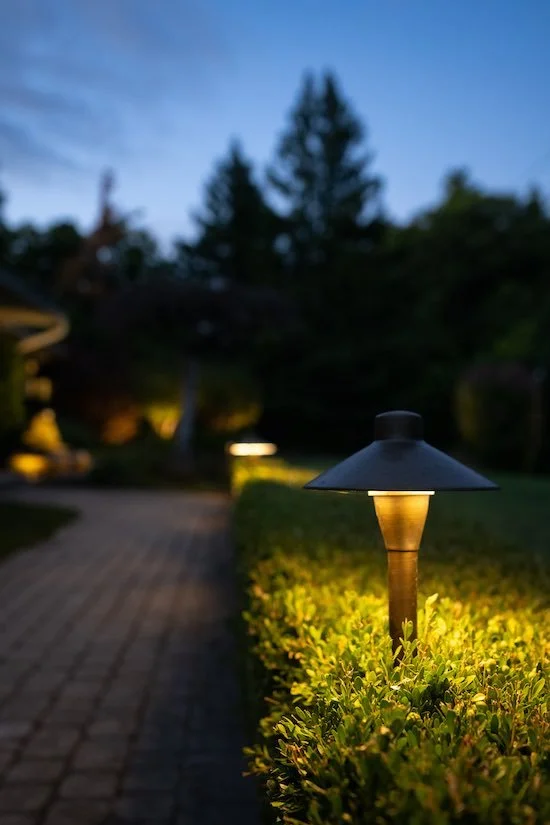
What we do
Light you never see, doing everything.
Outdoor & landscape lighting.
Path, garden, bed, facade and tree. Designed on your property, installed in solid brass and copper, aimed on a separate commissioning visit.
Installation ii.Outdoor audio.
Buried subwoofers and satellite speakers, zoned with the lighting and controlled from the same app. Same trench, same visit, one crew.
Installation iii.Service & repair.
Re-aiming, transformer and zone faults, fixture and speaker replacement. A flat $195 inspection documents every fixture in writing — whoever installed it.
Service iv.Curb appeal lighting.
Facade, frontage and the walk to the door — how the house reads from the road, and steps and grade changes lit for safety without glare in your eyes.
Installation v.Architectural lighting.
Stone, brick and detail grazed from close in. Beam angle and mounting distance set to the material rather than to the wall.
Installation vi.Pool & water lighting.
Surround, feature and reflection. Low voltage everywhere it can be, and the line-voltage side under our own ECRA/ESA licence.
InstallationWhy brass
Aluminum is cheaper on day one. Ask about year six.
Aluminum fixtures pit, chalk and start letting water into the housing within about six years — faster near road salt or a pool deck. Once water is in the housing, the failure isn't the fixture, it's the wire.
We specify solid brass and copper on every project — low-voltage, 3000K LED, with a lifetime fixture warranty. Brass patinas to a dark bronze over three or four seasons and then stops changing. See the full standard.
What it does for you
Four things a good evening is made of.
-
i.
The arrival.
A resort spends its budget on the drive in. Your property has that moment every night and usually answers it with a motion sensor. We design the approach: stone grazed from below, canopy overhead, a walk that lights ahead of you and fades behind.
-
ii.
The atmosphere.
You should never meet the fixture. Everything is shielded, tucked into planting and aimed away from where you sit, held to one warm tone across the property. Steps and grade changes get light at knee height — legible, with nothing in your eyes.
-
iii.
The hours.
Ontario gives you long evenings and takes them back in September. Zoned scenes mean the same deck can be a quiet Tuesday or a table of twelve, and dinner outside no longer ends when you can't see the table. When the season turns, seasonal warm-white runs on the same circuits.
-
iv.
The permanence.
Nothing in a finished design should flicker or lean. Brass and copper, buried runs, correct transformer loading, and one visit a year to re-aim what growth and frost moved. Year eight looks like night one.
Built for this climate
Ontario is hard on buried hardware. That's the whole spec.
Forty degrees of swing between January and July works at every gasket and connection. Road salt and pool chloride attack housings. Frost heave rotates a fixture a few degrees over a winter, and a plow contract finds anything set too close to the drive.
So: solid brass and copper, low-voltage LED throughout, gel-filled direct-burial connectors, transformers loaded to 80% of rating, and wire buried at depth. Then one maintenance visit a year to re-aim what the ground moved. See what a visit includes, or how we arrive at a spec.
How it works
From first call to final aim.
-
i.
Consultation.
A 45-minute visit with a portable kit. We walk the property, listen, and demonstrate effects on your actual architecture — not on a rendering.
-
ii.
Proposal.
Fixture counts, zone architecture, beam spreads, transformer sizing and itemized pricing, in writing. Yours whether you hire us or not.
-
iii.
Installation.
One crew, start to finish. Hand-dug inside root zones, sealed direct-burial connections, lawn and beds closed the day they're opened.
-
iv.
Commissioning.
A separate visit once it's in the ground, with you there. Every fixture aimed individually, scenes set, output tuned down until it reads right.
Real Ontario pricing
What it actually costs.
Published before you call, because the alternative is three site visits to find out we were never in the same range.
Economy.
$3,000 – $5,50010–20 fixtures · Front of house
Signature.
$5,500 – $11,000Fully designed · 20–35 fixtures
Reserve.
$11,000 – $21,000More features and control · 35–60 fixtures
Legacy.
$28,000 +70+ fixtures · Custom controls
Selected work
Six properties, all of them at night.
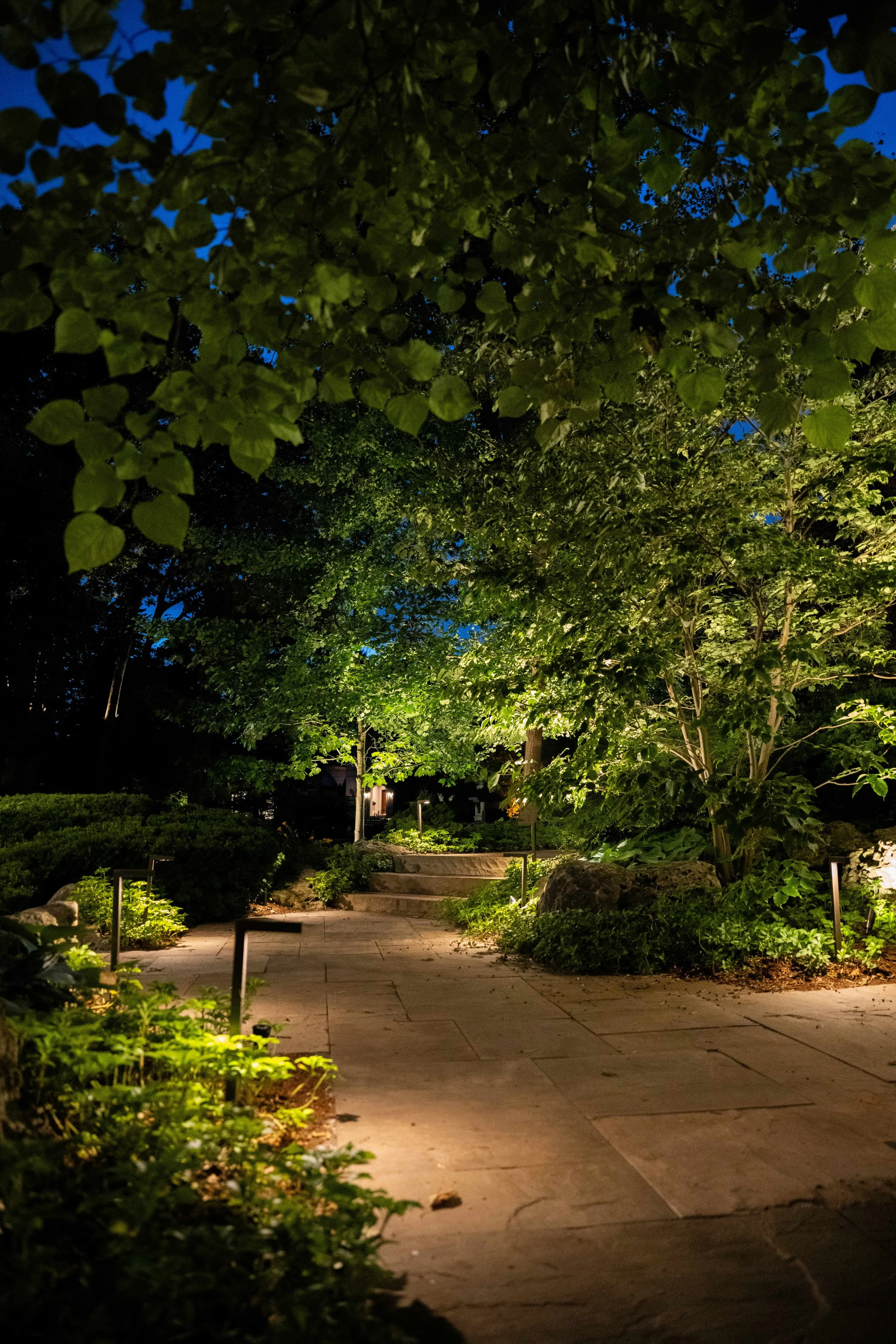
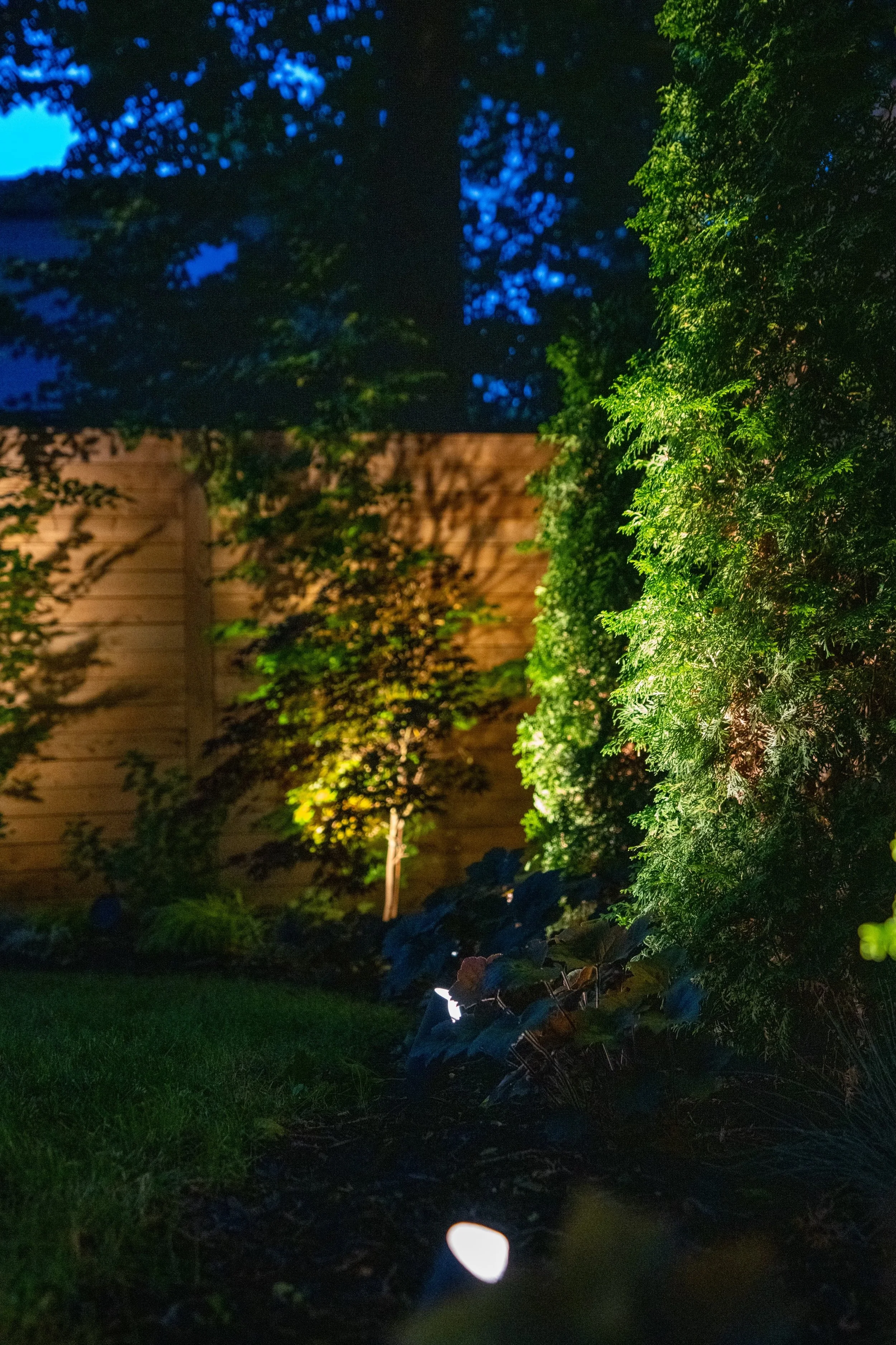
Canopy uplit from two sides, fence left dark. — Burlington
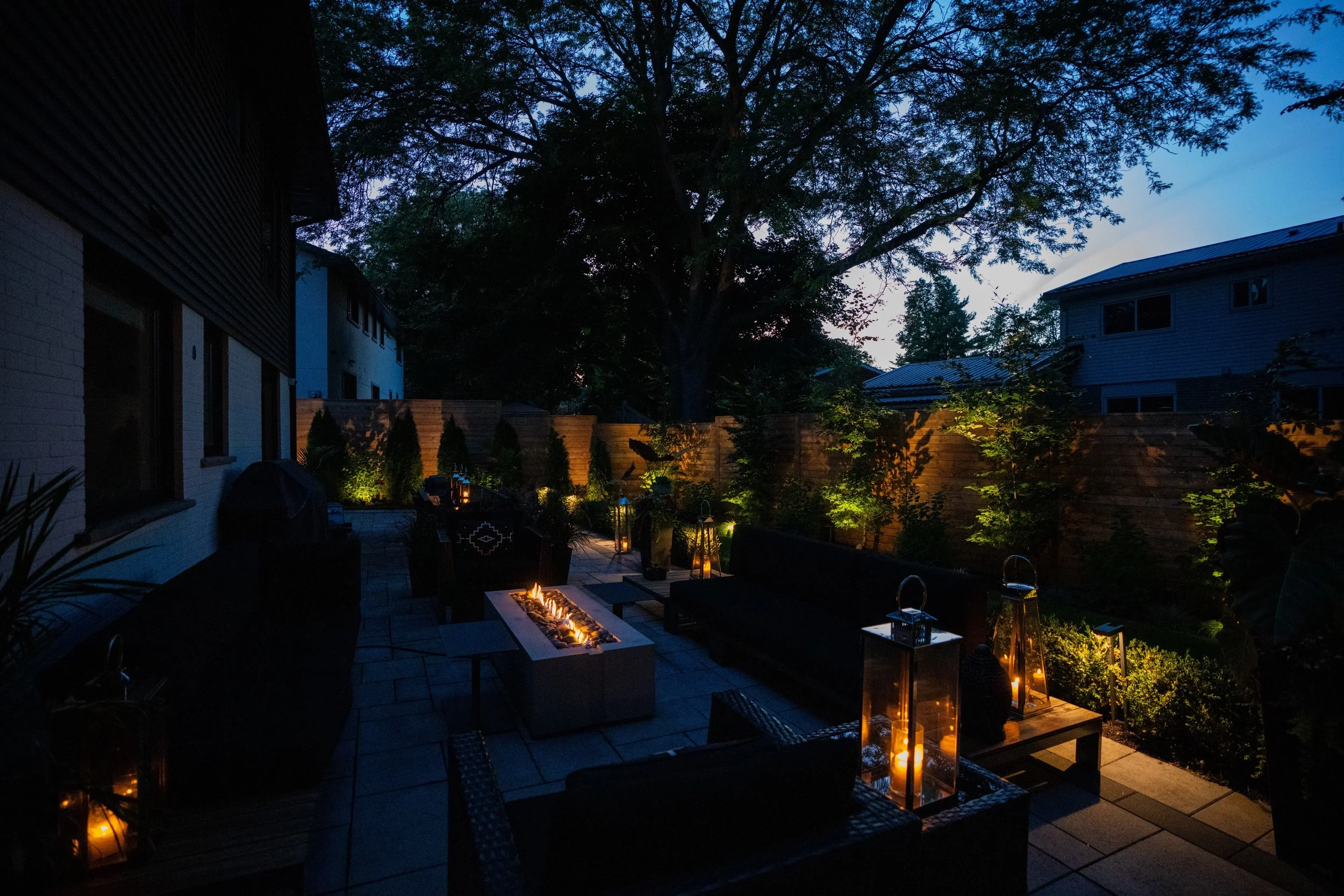 Courtyard and firepit, lighting and audio. — Mississauga
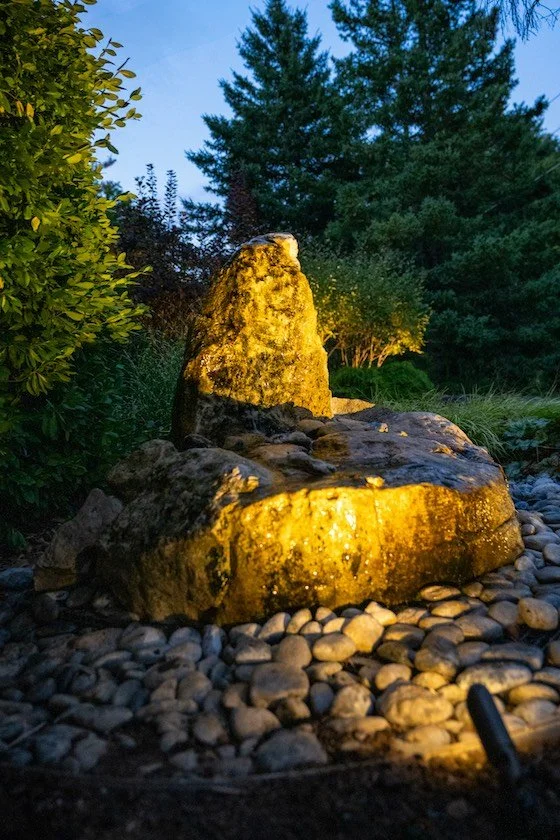 Stone outcrop, grazed low. — Campbellville
 Entry walk in bollards, doorway brightest. — Burlington
 Cedars from below, side yard left dark. — Mississauga
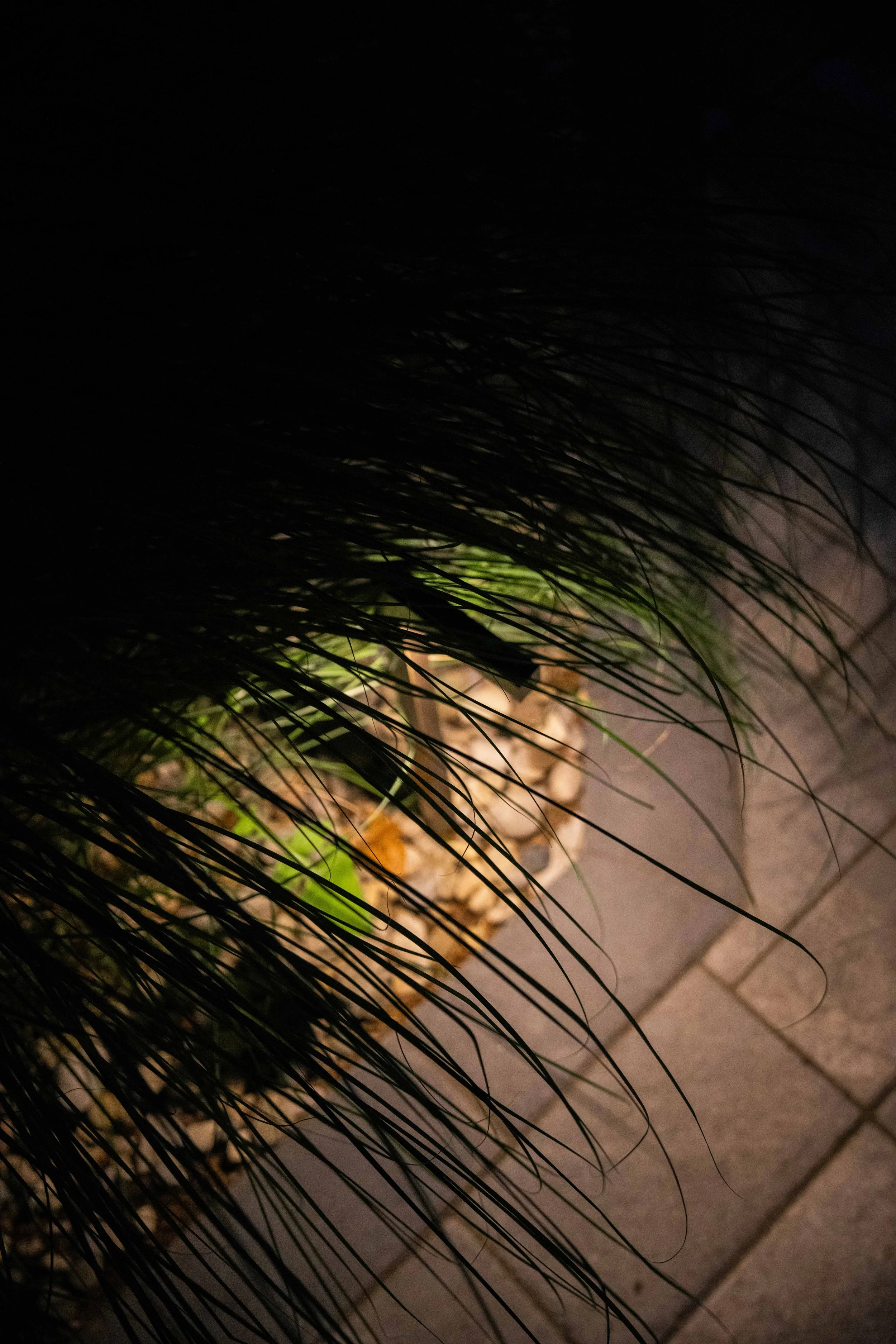
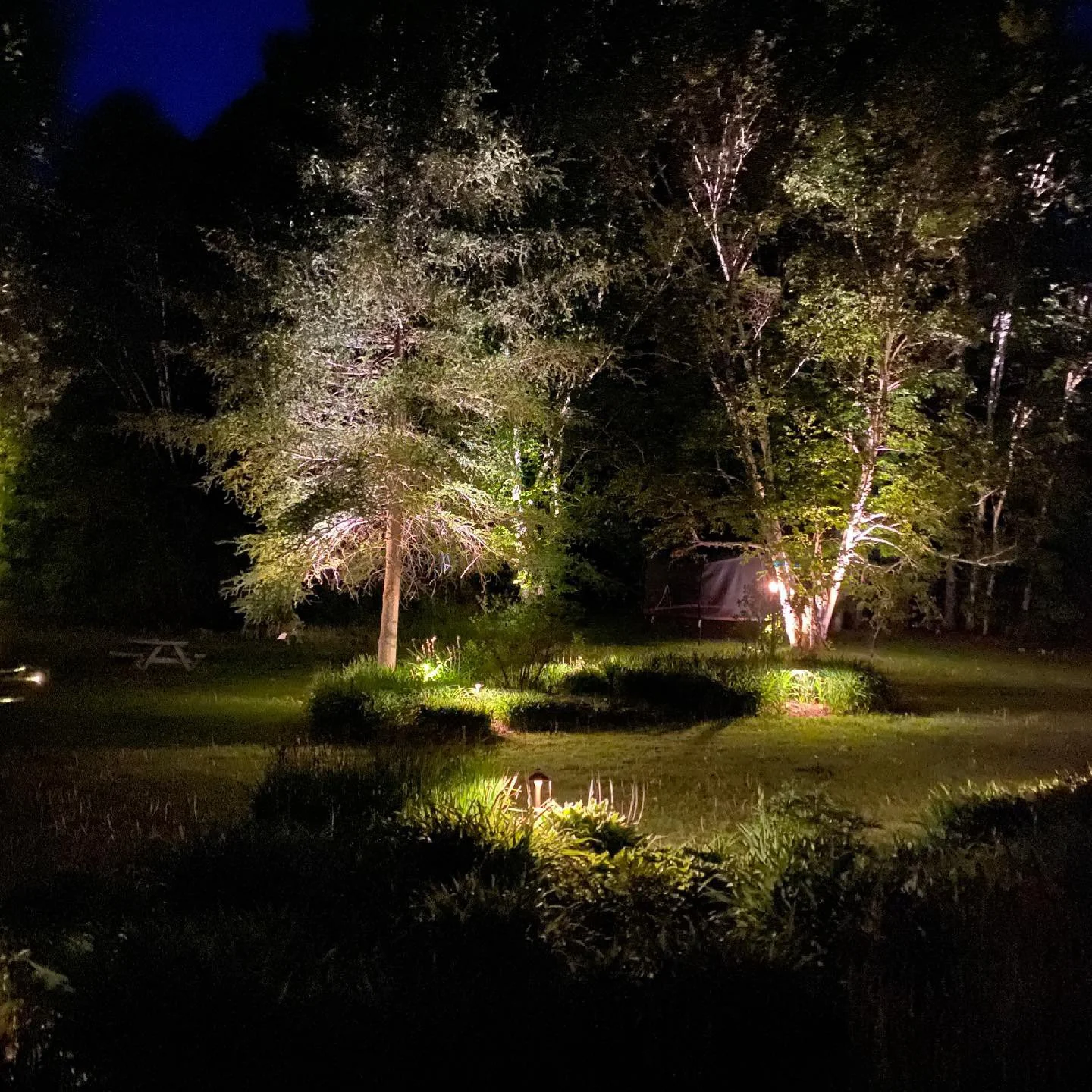 A long hedge, lit in intervals. — Muskoka
Where we work
Eighteen cities, and every one of them gets an evening.
Canopy in Oakville, ravine lots in Toronto, newer stone elevations in Vaughan, shield rock in Muskoka — the arrival is designed for what is actually on the property. Head office is in Milton; the five core cities are inside an hour and everything further out is scheduled in batches, so the designer who walked your property is the one on site for the aiming. All service areas, and what makes each one different.
Toronto.
Landscape lighting in Forest Hill, Rosedale, Lawrence Park and the Bridle Path.
Canopy and grade ii.Oakville.
Outdoor lighting for Old Oakville, Morrison, Eastlake and the lakefront estates.
Stone and frontage iii.Burlington.
Landscape lighting design across Roseland, Shoreacres and the Lakeshore corridor.
Grade and escarpment iv.Mississauga.
Landscape lighting in Lorne Park, Mineola and Port Credit.
Wooded lots v.Vaughan.
Outdoor lighting for Kleinburg, Thornhill and the Nashville estates.
Estate distance vi.Richmond Hill.
Landscape lighting design across South Richvale, Bayview Hill, Oak Ridges and the Mill Pond.
Open frontages vii.Markham.
Landscape lighting in Unionville, Cachet, Angus Glen and Thornhill Woods.
Heritage and estate viii.Aurora.
Outdoor lighting for Aurora Highlands, Hunters Glen and Beacon Hall.
Heavy canopy ix.Newmarket.
Landscape lighting design across Stonehaven, Glenway and the streets around Fairy Lake.
Tight frontages x.King City.
Landscape lighting in King, Nobleton, Kettleby and the moraine estates.
Acreage xi.Caledon.
Outdoor lighting for Caledon East, Palgrave, Terra Cotta and Belfountain.
Dark skies xii.Etobicoke.
Landscape lighting design across the Kingsway, Humber Valley and Princess-Rosethorn.
Textured facades xiii.Halton Hills.
Landscape lighting in Georgetown, Glen Williams and the Limehouse concessions.
Heritage stone xiv.Ancaster & Hamilton.
Outdoor lighting for Ancaster Heights, the Meadowlands and Dundas.
Escarpment rock xv.Guelph.
Landscape lighting design across Old University, Old Guelph and Kortright Hills.
Limestone xvi.London.
Landscape lighting in Old North, Old South, Byron and Sunningdale.
Batched trips xvii.Georgina & Lake Simcoe.
Outdoor lighting for Jackson’s Point, Roches Point, Sibbald Point and Sutton.
Waterfront xviii.Muskoka & Collingwood.
Landscape lighting design across Port Carling, Lake Rosseau, Blue Mountain and Georgian Bay.
Shield rockQuestions, answered plainly
Before you call.
How much does outdoor lighting cost in Ontario?
Most complete residential systems in the GTA fall between $3,000 and $28,000. A focused front-of-house design with 10 to 20 brass fixtures runs $3,000 to $5,500. A fully designed property — front, approach and primary rear space, 20 to 35 fixtures — runs $5,500 to $11,000, and that is where most homes land. Pool decks, hardscape and app-controlled zoning put a project in the $11,000 to $21,000 range. Multi-acre grounds with custom controls start around $28,000. Every range includes fixtures, wire, transformers, trenching, commissioning and warranty. Per fixture that is $250 installed at the front-of-house end and nearer $400 on estate grounds, where wire and transformers scale faster than fixture count does; a custom finish or optic adds about $150. The minimum project is $3,000.
Why do you design on site instead of from a plan?
Because a drawing can't tell you how a property reads. Beam spread, mounting height and how a facade answers a grazing angle depend on the actual stone, the actual canopy and the actual sight line from the road — two houses with identical plans get different lighting. So we arrive with a portable kit of the same brass fixtures we install, mark every position on the property, and show you the effects on your own architecture. Every effect in the final design is one you already approved standing in your own driveway.
Do you install outdoor audio as well as lighting?
Yes, and we install both — it's a second service line, not an add-on. True Audio buried subwoofers and distributed satellite speakers on Sonos amplification, zoned with the lighting and run from the same app. The two systems want the same trench, so installing them together costs meaningfully less than retrofitting audio into a finished lighting install and means the zones line up: one patio scene brings up the patio lights and the patio speakers together. A single-zone patio system runs $4,500 to $9,000 installed.
Do you service systems installed by someone else?
Yes. A $195 flat inspection documents every fixture, zone, transformer and connection in writing, regardless of who installed it or what brand is in the ground, and tells you honestly what's worth keeping. Solid brass fixtures with failed lamps are usually salvageable — roughly half the systems we inspect keep at least their transformer and trunk wire. Pitted aluminum housings, twist-cap connections in soil, or a transformer loaded past 90% of rating are reasons to phase in a replacement. From there you can go on a maintenance plan, repair, or do nothing.
How much of the property should actually be lit?
About a third, and the restraint is the whole craft. Light everything and you get a flat, over-exposed yard where nothing stands out because everything competes — the look most people are thinking of when they say they don't want landscape lighting. We choose the elements worth seeing: the facade, two or three specimen trees, the entry, a stone feature, the grade changes you walk on. Everything else stays dark on purpose. The unlit space between two lit trees is what makes either of them read, and it's why a well-designed system uses fewer fixtures than people expect.
Will it bother my neighbours?
Not if it's aimed properly, and that's most of what commissioning is for. The principle is simple: your light belongs on your property, not in someone's window and not in the sky. We use shields, glare guards and hex louvres on anything aimed up, full-cutoff fixtures wherever a downlight will do, and 3000K at low output rather than brightness turned up to compensate for bad aiming. That is the dark-sky principle and we build to it by default: light aimed down, sources shielded, nothing spilling past your property line. A correctly designed system is visible as lit stone and lit canopy — you should never be able to look directly at a source from a neighbouring property or from the road.
Your home, next
See it before you buy it.
We come out after dark and light your property temporarily, so you can stand in it before you commit to anything. Free, 45 minutes, no renders.
Book Free Evening Demo 888-444-1530